 PlayNObey
Playing
A kink checklist for couples, and what to do with it
In short
A kink checklist is a long list of activities that each of you rates on your own, privately, before comparing notes. The rating is not the point — the comparing is. It moves the conversation about limits onto paper, where nobody has to find the words in the moment, and where a "no" costs nothing to write down.
- Fill it in separately and privately, then compare — filling it in together produces answers aimed at the other person
- A hard limit needs no reason, and a list that asks for one is badly designed
- The useful output is the overlap and the surprises, not a score
- Answers are the most sensitive thing in a D/s app, so where they are stored matters more than for anything else
- In PlayNObey the list is 251 items, the answers stay on the device, and nothing in the app reads them yet
On this page
What is a kink checklist?
A kink checklist is a list of activities, usually a few hundred long, that each partner rates on their own — typically from "no, never" through to "want to". You fill it in separately, then compare, and the comparison is the actual product. Everything else is a prompt.
The format has been circulating in the community for about two decades in various forms, and the reason it has lasted is not that it is clever. It is that it inverts the hard part. Saying an unfamiliar thing out loud to somebody whose reaction you cannot predict is difficult; ticking a box on a list of three hundred boxes is not. By the time you compare, every item on the page has already been considered once in private, which is where consideration is easiest.
It is also the closest thing this category has to a standard. Most people arriving at a D/s app have either filled one in before or have heard of one, which makes it a reasonable thing to expect an app to carry.
Does going through one actually help?
It helps with a specific, narrow thing: finding out what the other person wants that you did not know about, and finding out where a hard no sits before you walk into it. It does not do anything else, and lists that promise more oversell themselves.
The two useful outputs are worth naming, because neither is a score.
The overlap. Items you both rated highly. This is usually shorter than either of you expected, and it is the list you should actually be working from — not the union of both wish lists.
The surprises. Items one of you rated highly that the other had never considered. These are where a checklist earns its keep, and they are almost always things that would never have come up in conversation, because neither of you had a reason to raise them.
What a checklist does not produce is a plan. A rating of 5 against an activity says "I am interested in this", not "I want this on Friday". Treating a filled-in list as a menu to work through is the most common way the exercise goes wrong, and it turns a shared reference into an obligation.
How do you fill one in without it becoming a negotiation?
Separately, privately, in one sitting, and without discussing any item until both of you have finished. The failure mode is filling it in together — answers then get aimed at the other person's face rather than at the question, and you end up with a document that records what each of you thought the other wanted to hear.
Four things that make the difference:
- Do not explain yourself while filling it in. A hard limit needs no reason. Any list that asks for one is badly designed, and any partner who asks for one has misunderstood what a limit is.
- Rate the activity, not the version of it you are imagining. Most items on these lists cover a range from very mild to very intense, and people routinely rate the extreme version and write off something they would have liked.
- Use the "tried it" mark honestly if the list has one. Never having done something is different information from having done it and not liked it, and collapsing the two loses the more useful half.
- Set it down when you get bored. Two hundred and fifty items is long enough that fatigue starts producing noise around item ninety. Answers given to get to the end are worse than no answers.
Then compare. Not as a document handed over, but sitting next to each other going down the list — because the interesting part is the reaction to a surprise, and that is not in the file.
Where do your answers go?
Into somebody's database, in almost every app that offers one — and this is the single most sensitive thing a D/s app will ever hold about you. It is worth checking before you fill one in, rather than after.
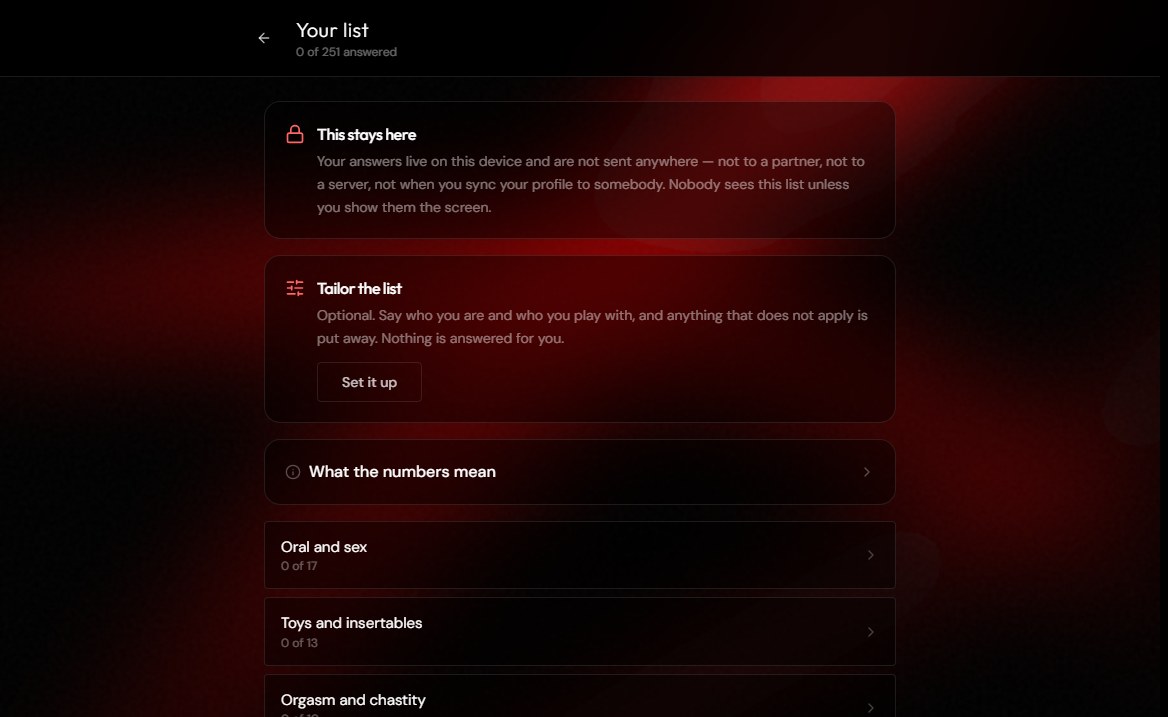
In PlayNObey the list is 251 activities, each rated as a hard limit or from 0 to 5, with an optional mark for whether you have tried it. The answers are written to the local database on your device and stay there. They are not sent to us, they are not sent to a partner, and they are deliberately stripped out when you sync your profile to somebody — that last one was a real gap during development, because profile sync serialises a persona wholesale and a new field rides along by default. It now passes through a filter, and there is a test that reads the sync code and fails if that ever gets undone.
You can also narrow the list before starting. Saying who you are and who you play with puts away everything that does not apply, which is the difference between a list you finish and a list you abandon. Nothing is answered for you.
What the list will not do for you yet
Nothing in PlayNObey currently reads your answers. No quest builder pulls from the things you rated highly, and nothing checks a dare against your hard limits before putting it on a wheel. The list is a reference you keep, not an input to the rest of the app, and we would rather say that plainly than let the feature imply more than it does.
Comparing lists with a partner in the app is also not built, and that one is deliberate. Sending your answers to another device would mean your answers leaving your device, which is the thing the page promises they will not do. The shape that solves it is passing one phone between two people rather than transmitting anything, and that is how it will be built when it is built.
In the meantime the list works the way it always has: two people fill one in, then sit down together with it.
What a list cannot settle
Anything about the day you are actually having. A checklist is filled in calmly, in advance, about activities in the abstract — and nothing on it tells you whether either of you wants any of it tonight. That is what a check-in at the start and a way to stop in the middle are for, and no amount of preparation replaces them.
It also goes stale. People's answers move, in both directions, and a list filled in eighteen months ago is a record of who you were then. Re-doing one occasionally is more useful than treating the first as settled.
If you want somewhere to keep one, PlayNObey has the 251-item list built in, free, with the answers held on your own device. It runs in a browser, on Windows and on Android, and you do not need an account to use it.
Dares, proof, and a wheel that decides — on a local-first app where everything you make stays on your own device.
Open PlayNObey