 PlayNObey
Playing
Punishments in a D/s app, and when to leave them off
In short
A penalty is what happens when proof of a dare is turned down. In PlayNObey it is a weighted wheel you fill in yourself, and an empty wheel means a refused proof costs nothing — which is a legitimate way to run a board, not a setting you forgot. Consequences are worth adding once refusing has started to feel free, and not before.
- A penalty fires on a refused proof, which is a normal part of the loop rather than a failure
- The wheel is seeded on the proof itself, so both devices land on the same cell without asking each other
- An empty penalty wheel is a working configuration — a board you build has one until you add cells
- A starter pack installs a penalty catalogue with the board, so a first board made that way arrives with the wheel populated
- A consequence that cannot be carried out within a few minutes will be renegotiated instead of done
On this page
What is a penalty wheel?
A penalty wheel is what happens after a proof is turned down. The person who set the dare rejects the photo, a wheel spins, and it lands on one consequence out of however many you put on it. Each cell carries a weight, so a mild one can come up four times as often as a serious one.
The important word is after. A penalty is not a punishment for refusing to do something — refusing is always allowed and costs nothing. It is what follows a dare that was attempted and where the proof did not satisfy the person who asked for it. Those are different situations and conflating them is how an app turns a game into an obligation.
Should a first board have punishments at all?
Often not. A board with no consequences works perfectly well, and starting without them tells you something useful: whether the two of you actually want them, or whether you added them because the app had a slot.
The case for leaving them off for a while is practical. Consequences are the part of a D/s dynamic that most needs both people to want it, and the only reliable way to find out is to run a few evenings without any and notice whether refusing has started to feel free. If it has, that is the moment a consequence adds something. If it has not, one would only be decoration.
This is a real split in the category rather than an idiosyncrasy. Embrace has no punishment system at all, by design, and that is a coherent product rather than a missing feature. Most of the trackers — Obedience, Kneel — treat consequences as core, because a habit tracker without a cost for missing a day is just a list.
How is it set up?
In the board editor, under the penalty wheel. You add cells, give each one a weight, and that is the whole configuration. An empty wheel is a valid state and the editor says so in as many words.
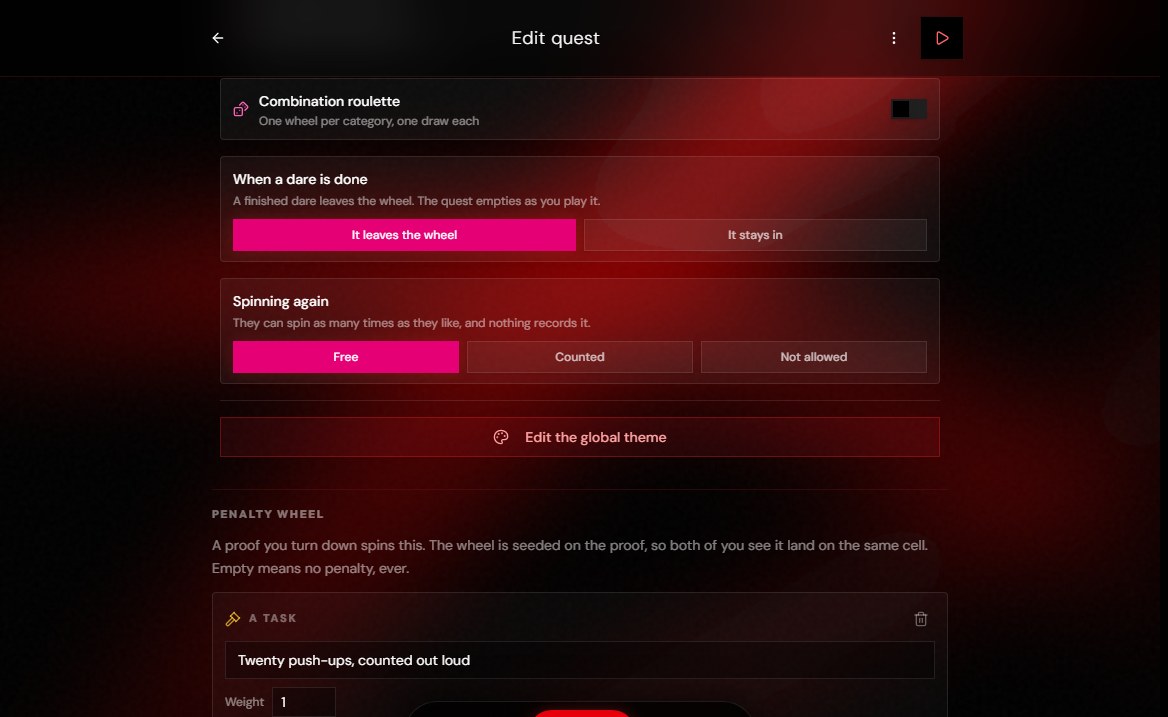
There is one exception you should know about before your first board, because it is the opposite of what the rest of this page describes. A board you build yourself starts with an empty penalty wheel. A starter pack does not — it installs a penalty catalogue along with the board, so the fastest way to get a first board is also the way that arrives with consequences already configured. You can empty it in the editor in a few seconds, but it is there unless you do.
The same screen carries the two rules that matter more than the penalties do: whether a finished dare leaves the wheel or stays in it, and whether spinning again is free, counted or not allowed. Those two settings change how an evening feels far more than the contents of the penalty wheel.
Why a wheel rather than a list?
Because a wheel is seeded on the proof it is punishing, which means both devices land on the same cell without having to ask each other. Nobody picks, and nobody can be accused of having picked.
That is a genuine technical property rather than a flourish. The spin is derived from the proof record itself, so the person who took the photo and the person who rejected it both see the same result, and it is the same result if either of them reopens the app tomorrow. There is no round trip, which also means it works when one of you is offline.
The social effect is the one that matters in the room. A consequence chosen in the moment by the person who just rejected your photo is a decision, with everything that follows from a decision — including the suspicion that it was chosen to be harsh. A consequence that fell out of a wheel both of you filled in weeks ago is not.
How do you write a consequence that works?
The same way you write a dare that works: small enough to start immediately, specific enough that nobody has to interpret it, and finishable within a few minutes. A consequence that needs planning gets renegotiated, and a renegotiated consequence teaches the board that it can be argued with.
Four shapes that hold up:
- Something physical and countable. A number of something, counted out loud. Unambiguous, over quickly, and nobody has to judge whether it was done.
- A transfer of choice. The other person decides the next thing — what you wear, what you drink, what happens next. Reusable indefinitely.
- A repeat with a stricter proof. The same dare again, with a longer or clearer photo. This is the one that actually addresses a refused proof rather than changing the subject.
- A short constraint with a clock. One rule, for five minutes.
Two to avoid. Anything that has to happen later — a consequence deferred to tomorrow rarely survives contact with tomorrow. And anything genuinely unwanted by the person carrying it out, which turns the wheel from a game mechanic into a reason to stop handing back proof at all.
What about consequences a device carries out?
A penalty cell can drive a connected toy instead of asking for an action, at a level and duration set on the cell, capped by a ceiling you control on the devices screen. It fires once, on the phone of the person it applies to, and never on the other one.
Being accurate about the state of this: the connection works through Intiface Central running on the same machine, and the safety model — a per-device ceiling, yellow holding everything at zero, red stopping and staying stopped, everything stopping when the app leaves the screen — is tested thoroughly against a simulator. It has not been tested against real hardware. If you try it, treat the first session as a test of the plumbing rather than as part of an evening.
When to take them off again
When somebody starts choosing dares to avoid the wheel. That is the signal that the consequences have stopped being part of the game and started being the point of it, and the fix is to empty the wheel for a few evenings rather than to make the dares easier.
PlayNObey is free and the penalty wheel is yours to fill or leave empty. It runs in a browser, on Windows and on Android, and the board you build stays in a database on your own device.
Dares, proof, and a wheel that decides — on a local-first app where everything you make stays on your own device.
Open PlayNObey