 PlayNObey
Playing
Your first evening with a dare app
In short
Keep the first evening short, use a ready-made board rather than writing one, and agree how to stop before you agree on anything else. Most first attempts fail because they were too ambitious, not because they were too tame — six dares that happen beat thirty that get abandoned twenty minutes in.
- Agree how to stop before you agree what to do — it is the only part that has to be settled in advance
- A ready-made board removes the hardest step, which is writing dares while self-conscious
- Keep the first one short: six to eight items is a whole evening
- Proof is what makes it a game rather than a conversation, and it is also the part people forget to agree on
- A starter pack in PlayNObey arrives with a penalty wheel already filled in — empty it in the editor if you do not want one
On this page
How do you actually start?
Open the app, install a ready-made board, and spin it once. That is the whole first step, and it deliberately skips the part where you sit down to write a list of dares — which is the point most first attempts stall at, because writing them while self-conscious produces a list neither of you wants to use.
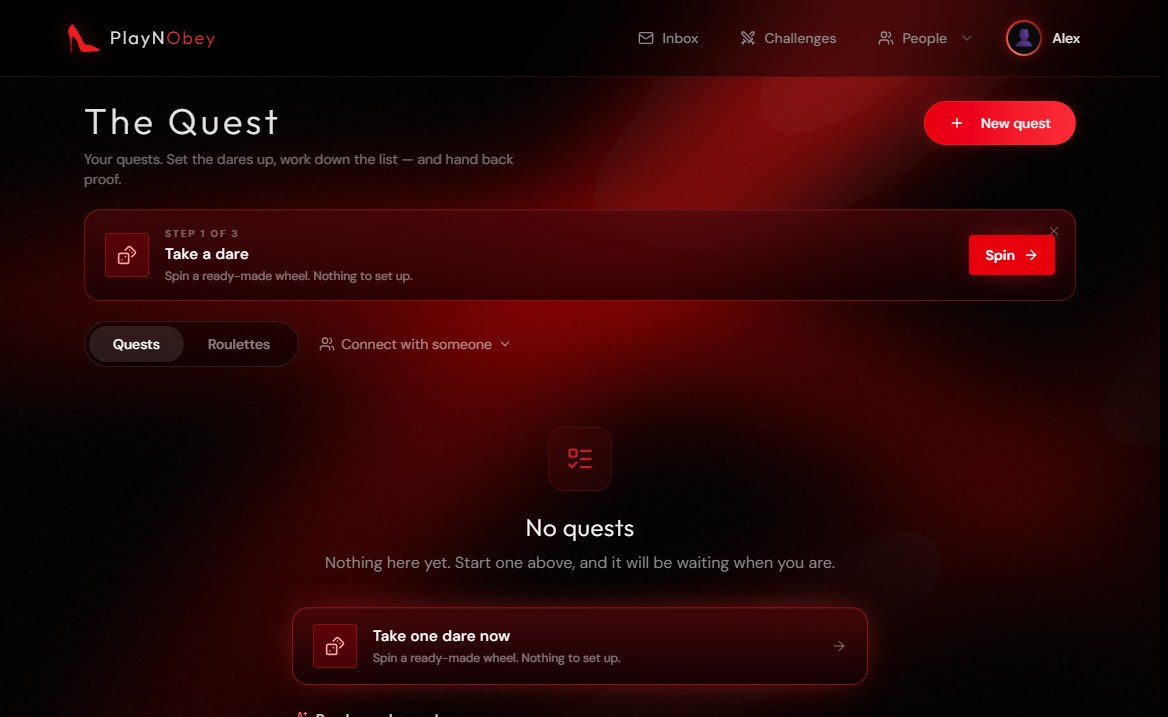
The reason to start with somebody else's board is not that their dares are better. It is that reading six of them tells you what a dare on a board looks like — short, specific, finishable — far faster than any advice about writing them does. After one evening you will want to replace most of them, and that is the intended outcome.
What should the first evening look like?
Short. Six to eight items, one sitting, an hour or so. The most common mistake is not being too tame — it is building something ambitious enough that it becomes a project, and a project gets postponed.
Three things worth agreeing before anything else, in this order:
- How to stop. A word, or a colour, or just "stop". This is the only part that genuinely has to be settled before you begin, and it takes about ten seconds.
- Who is deciding. One of you sets the board, one of you carries it out. Swap next time. Leaving it unstated means two people politely waiting for the other to lead.
- Whether there are consequences for a refused dare. There do not have to be. A board where nothing happens when something is skipped works perfectly well for a first evening.
What does not need agreeing in advance is what is on the board. That is what the board is for.
What happens when you spin?
The wheel picks one item and you do it. There is no scoring to understand and no turn structure to learn — the entire mechanic is that something other than the two of you decides what happens next.
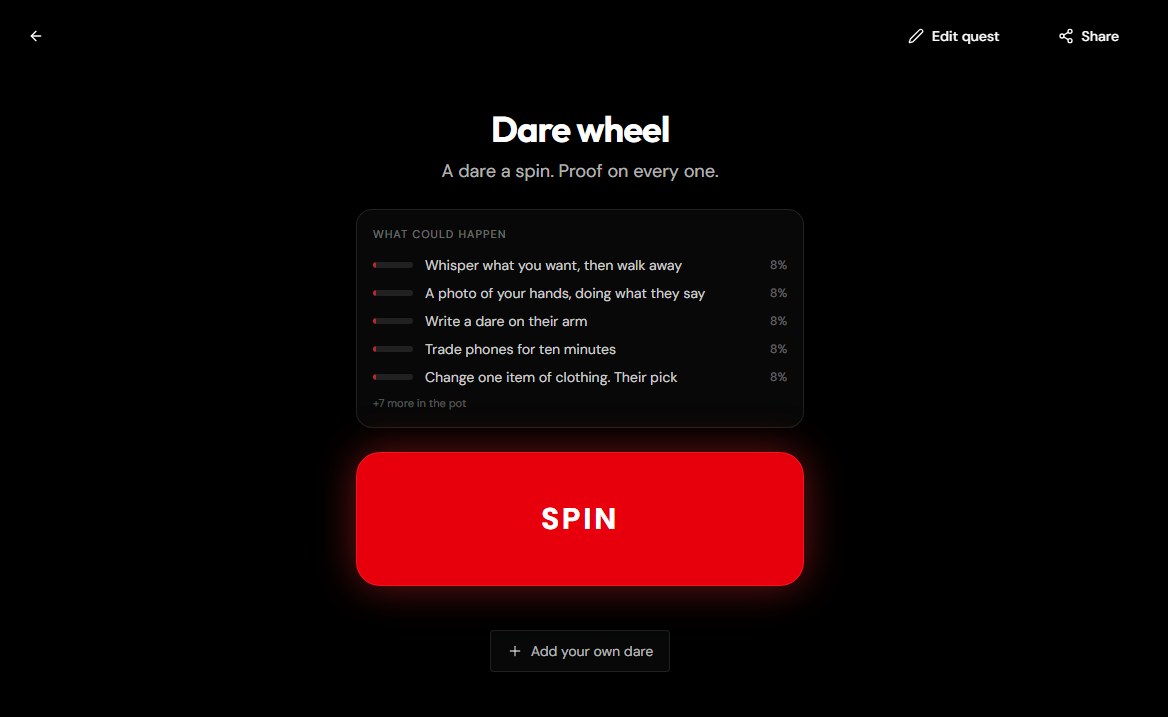
That sounds trivial and it is the reason the format works. The awkward part of a first evening is not doing any particular thing; it is being the person who suggests it. A wheel removes the suggesting. Nobody proposed the dare, nobody has to react to having proposed it, and both of you are on the same side of it.
The list of what could come up is visible before you spin, which matters more than it looks. Nothing on the board is a surprise in the sense of being unagreed — you have both seen every item. The surprise is only the order.
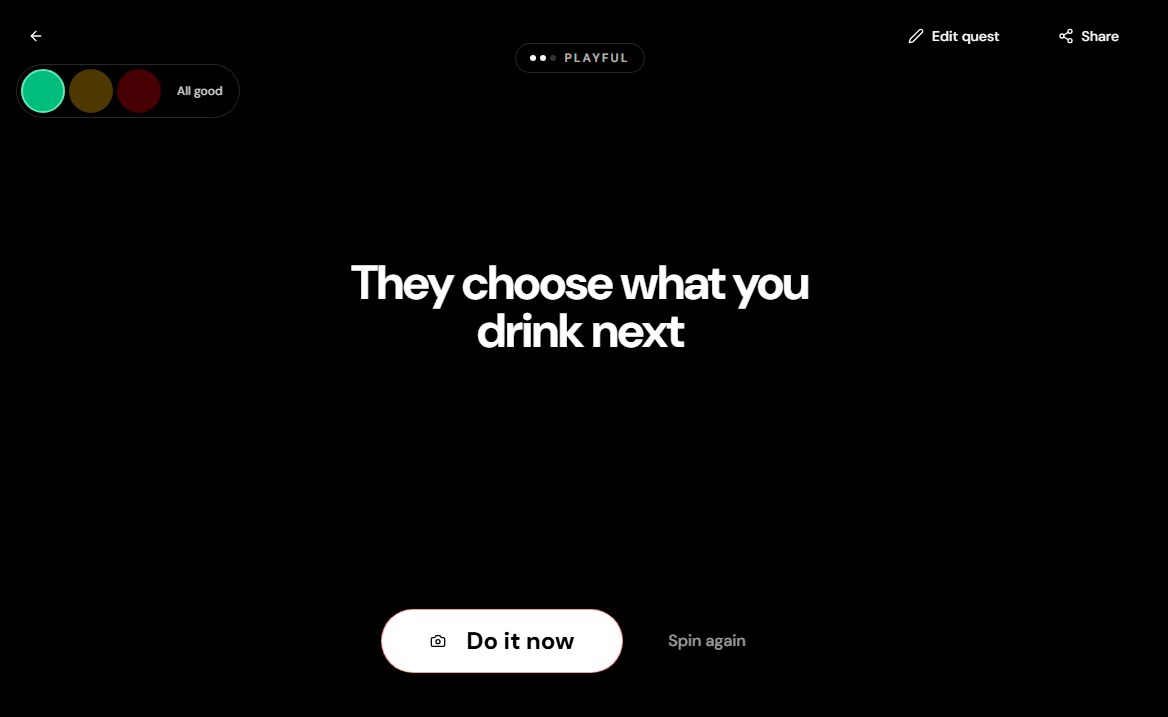
When it lands, you get the dare, a traffic light to say where you are, and a button to hand back proof. The traffic light is worth using rather than treating as decoration: yellow holds everything, red stops it.
What about proof?
Proof is a photo or a video handed back at the end of a dare, which the other person then approves or turns down. It is the part that makes this a game rather than a conversation about a game, and it is also the part people forget to agree on before starting.
Two things to settle:
- Whether every dare needs it. It can be per-item. A board where three of eight ask for proof is a perfectly normal board.
- Where the photos end up. This varies enormously by app, and it is worth knowing before rather than after. In PlayNObey a proof photo is written to the local database on the device that took it; sending one to a paired partner is a deliberate act and it is encrypted before it leaves. What that means in detail is its own page.
The refusal case is the one worth thinking about. A proof being turned down is a normal part of the loop, not a failure state, and what happens next is entirely up to how the board was set up.
Do you need a second device?
No. One phone passed between two people is the simplest version of this and it is how most first evenings go — there is nothing to pair, nothing to connect, and nobody has to install anything.
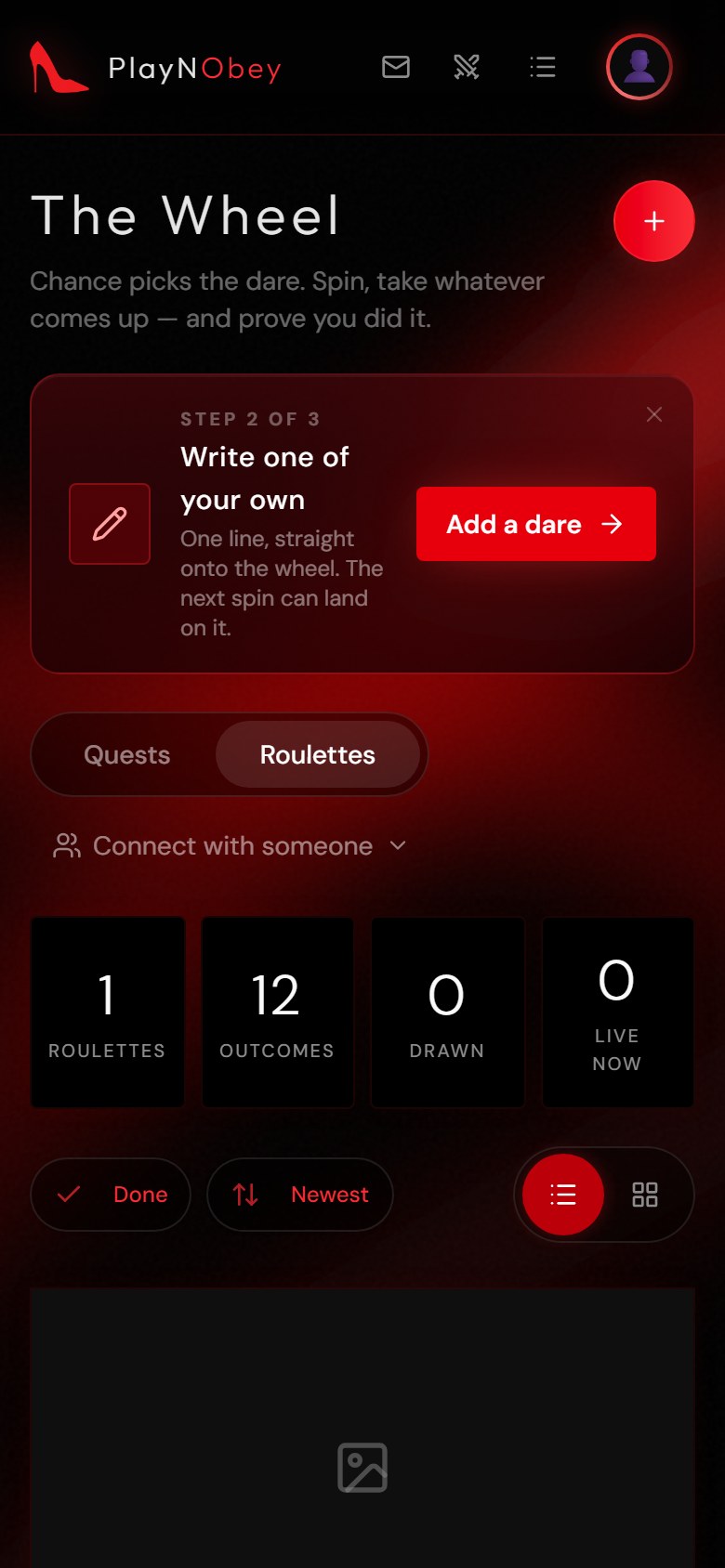
Two devices become useful when you want each person to have their own view — a dare arriving on one phone, proof going back to the other — or when you are not in the same room. Pairing is a six-digit code rather than an account, and it can wait until you know you want it.
A note on penalties
A board you build yourself in PlayNObey has an empty penalty wheel, and a refused proof costs nothing until you add something to it. A starter pack is the exception: it installs a penalty catalogue along with the board, so a first board made the fast way arrives with the wheel already populated.
That matters for a first evening specifically, because the fast way is the way we just recommended. If you would rather nothing happened when a proof is turned down, open the board editor and empty the penalty wheel before you start — it takes a few seconds, and it is better to know it is there than to discover it.
How do you stop?
You put the phone down. There is no completion state to reach and no streak to break, which is the practical difference between this and the habit-tracker apps that make up most of the category — nothing is counting, so stopping in the middle of a board costs nothing and leaving it for three weeks costs nothing either.
If it went well, the thing to do next is not a bigger board. It is replacing four of the eight items with your own, which is a ten-minute job and the point at which it stops being somebody else's game.
PlayNObey is free, runs in a browser, as a Windows app and as an Android app, and needs no account to start. Confirm you are 18 or over, install one board, and spin it once.
Dares, proof, and a wheel that decides — on a local-first app where everything you make stays on your own device.
Open PlayNObey